Laboulaye and Levasseur’s journal
April 13, 2011
When Édouard Laboulaye, the Frenchman who shepherded the Statue of Liberty from idea into construction, wrote a novel about liberty in America, he drew on another experience recorded by Levasseur. Shortly after Lafayette’s arrival in New York in August 1824, a fire broke out a few blocks from where he and his companions were staying. Hearing the bells and the sound of fire trucks passing, Levasseur and George Lafayette rushed into the street to join the crowd headed toward the fire. Once there, the two Frenchmen watched the fire fighters in action and spoke with one of the police officers about their progress. Levasseur was duly impressed by the courageous firemen – volunteers, he learned – and by the order that prevailed among the onlookers, “without the aid of a single bayonet or uniform.” The experience led him to a favorable conclusion about a democratic society’s effect on its citizens: people maintain order and respect the law when they, as opposed to an authoritarian ruler, are the authors of their laws.
Édouard Laboulaye took this as a theme for his novel, Paris in America. And he used Levasseur’s story about courageous volunteer firemen as the basis for a lively scene in the opening section of his book.
Levasseur’s journal
April 12, 2011
Lafayette’s secretary Auguste Levasseur recorded Lafayette’s 1824-1825 visit to the U.S. in a detailed journal that was published in France a few years following their return home (this is the journal Alan Hoffman recently translated). Levasseur depicted the remarkable outpouring of affection for Lafayette. But equally intriguing for some of his readers were the American habits and way of life that his stories revealed.
One experience involved the president of the United States in 1825, John Quincy Adams. Having returned to Washington D.C. at the end of his year-long tour of the U.S., Lafayette mentioned to President Adams that he would like to visit James Monroe, Adams’s predecessor, before departing for France. Adams offered to take Lafayette to see Monroe at his home near the capital and arranged for their small group to travel by carriage (Lafayette’s son, George Washington Lafayette, and Auguste Levasseur accompanied Lafayette throughout his trip). Crossing over the Potomac the two carriages stopped at a tollbooth and Adams paid for the group. As they started off, however, the toll collector ran after them, shouting, “Mr. President! Mr. President!” Apparently the president had given him too little. Adams counted the horses and passengers once more, agreed with the toll collector’s tally, and paid the missing 11 cents.
During their discussion the toll collector recognized Lafayette. He now insisted that, although the president was obligated to pay the usual fee, the “Nation’s Guest” (that is, Lafayette) could not be charged for crossing a bridge. After some more discussion, Adams convinced the collector that on this particular outing Lafayette was traveling as a friend of the president and therefore should pay the toll, the same as everyone else.
For Levasseur and his readers, the entire scene must have been at once astonishing and amusing. Who could have imagined chasing after the French king in this way?
Lafayette portrait
April 2, 2011
In my last post about Lafayette’s visit to the U.S. in 1824-1825 (note that this was a full 40 years after the Revolutionary War and his permanent return to France) I mentioned the naming of cities, streets, etc. in his honor. Another lasting tribute to the Marquis de Lafayette and his role in securing our independence, dating from that same visit, is the portrait that hangs in the House Chamber in Washington D.C. It was in December 1824, once word of the spirited welcome Lafayette received in the U.S. reached France, that the artist Ary Scheffer offered a portrait of Lafayette to the U.S. House of Representatives. The House not only accepted Scheffer’s painting but, rather than hang it in a hallway or a meeting room, displayed it on the front wall of the House Chamber, to the side of the Speaker’s rostrum (when the House moved, the painting was relocated to the current Chamber and the same prominent position). Ten years after receiving the painting of Lafayette, the House commissioned a portrait of George Washington for the other side of the speaker’s rostrum.
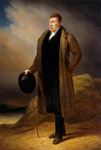
The Office of the Clerk of the U.S. House of Representatives web site shows the two paintings and gives a little information about them.
I can imagine the impression this made on Édouard Laboulaye, and other “friends of America” in France.
Graceland in Chicago
March 29, 2011
Graceland is the cemetery Erik Larson mentions in The Devil in the White City. Graceland is home to many architects and engineers – including Louis Sullivan, William Le Baron Jenney, Daniel Burnham, and Ludwig Mies van der Rohe – along with other prominent figures in Chicago history. Located in the city, just north of Wrigley Field, it is a surprisingly peaceful resting place. My parents’ site (partly shaded by the branches of a tree, near flowering landscaped areas, and within sight of the pond) is particularly lovely.
Anniversary day, March 27
March 27, 2011
When my father died in 1982, Bruce Graham wrote a eulogy for him. My father and Bruce had worked together for over twenty years. I believe they both felt that their collaboration and respect for each other inspired their creativity over the years. It was Bruce Graham’s enthusiasm for rational structures, my father once said, that strengthened his motivation to search for structural solutions worthy of expression.
I was reminded of the importance of this personal connection between engineer and architect last October when I attended a memorial service for Bruce Graham. Printed on the program for the service was not a eulogy for Bruce but rather the eulogy Bruce wrote for my father. His words eloquently conveyed the heartfelt respect he felt for my father, as an engineer and as a person, and it was deeply moving for me to read them once again. I also greatly appreciated Bruce’s family, together with his former partners at Skidmore, Owings & Merrill, choosing to feature his words about my father at a memorial service dedicated to Bruce.
And that was not all. With the help of SOM, Bruce Graham’s family obtained the plot next to that of my parents at Graceland Cemetery and placed a memorial stone for him there. As part of this work, the planting border around my parents’ stone was adjusted so that the two sites – Bruce’s and my parents’ – relate to each other. I am very happy about this new arrangement; and it means a lot to me to know that, 29 years after my father’s passing, his memory endures in this way. Still today, many people express to me their love and admiration for him – and I am sincerely grateful for this.
It is a gift my father left me.
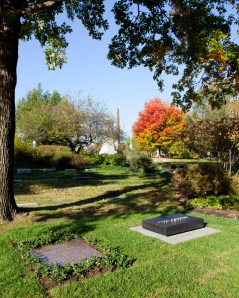
My parents’ gravestone (left) and Bruce Graham’s memorial stone at Graceland Cemetery, October 2010.
Princeton structures class studies my father’s work
March 11, 2011
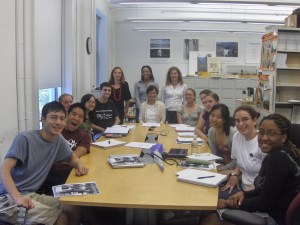
This last fall I was very happy to learn about a new course on building design at Princeton University. It is a structures class that looks at design in a social and historical context. Professors Maria Garlock and Sigrid Adriaenssens invited me to meet with their students to talk about my father and his work. When I visited in September we sat around a table–this photo was taken then–and two students, Liz and Megan, presented a list of questions the class had prepared in advance. A couple of weeks after my visit, Bill Baker, SOM’s structural engineering partner, visited the class to talk about current practice. Leslie Robertson did, too, later on, as well as Guy Nordenson. And Professor David Billington talked with the students about structural art.
As part of the course work, the class broke into small groups of two or three students each to study one of my father’s high-rise designs in more detail. Each group built a model of its selected building. These five models will soon be featured in an exhibition at the Engineering Library.
I was truly impressed when I received these photos of the models from Professor Garlock. I hope to visit Princeton this year to see the exhibition.


The five buildings modeled are the John Hancock Center in Chicago; the Sears Tower (now called the Willis Tower) in Chicago; the Brunswick Building in Chicago; One Shell Plaza in Houston; and Marine Midland Bank in Rochester.
Fazlur R. Khan Way
March 9, 2011
Displayed above the “Khan Sculpture” is the street sign that can be seen just outside the building, at the intersection of Jackson and Franklin Streets. The city named this intersection at the foot of the Sears Tower (now the Willis Tower) in honor of my father in 1998.
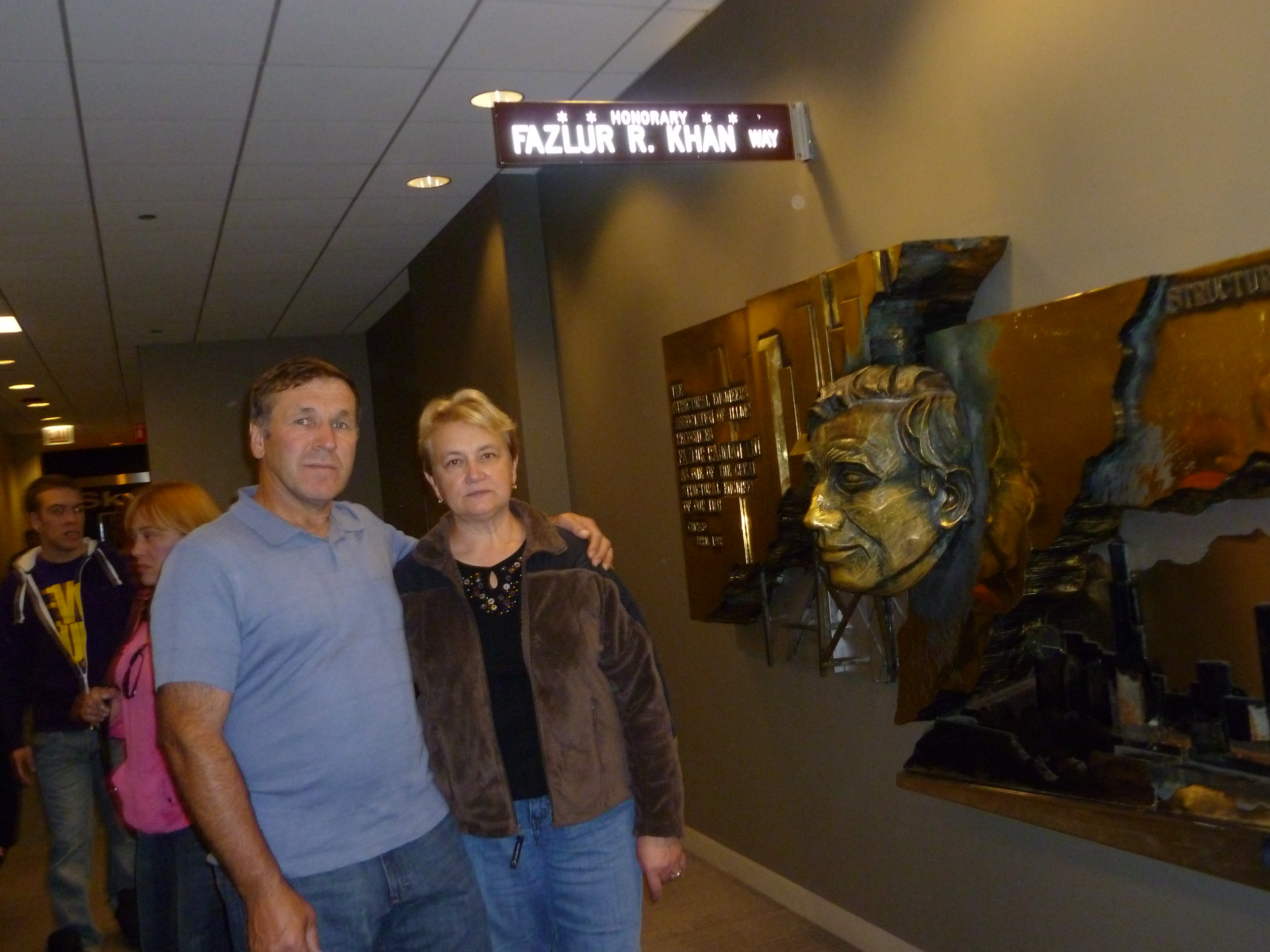
Our friends Vasyl and Luba at the Sears Tower last October
Lafayette in America
March 3, 2011
Against the wishes, and orders, of Louis XVI, Lafayette quietly prepared for over a year to join the Continental Army, and, in the spring of 1777, he set sail for the colonies. Things went his way. He met the commander-in-chief, George Washington, and the two men took to each other immediately. In fact, a number of American generals liked Lafayette, a “most sweet tempered young gentleman,” as General Nathanael Greene described him.
So he was given a chance to prove himself, which he did consistently. And, in 1781, he set the stage for the victory that finally pointed the war to its end. With a small American force in Virginia–and with patience and good judgment, and some good luck, too–Lafayette caused General Charles Cornwallis, second in command of the British army in North America, to pull back his troops to the coast near Yorktown. The British soon found that they were in a bad location at the wrong time, trapped by a gathering of American and French forces. Alerted by Lafayette, Washington and Rochambeau quickly marched their troops from the north, and Admiral de Grasse moved in with his large French fleet. On October 19, 1781, Cornwallis surrendered his troops to Washington, marking the American victory at Yorktown. Lafayette was 24 years old.
Which brings me back to Lafayette’s spectacular visit to the U.S. in 1824-1825. On account of his youth during the Revolutionary War, he was the last surviving general in 1824, when the U.S. Congress and President Monroe invited him to visit the U.S. as a “guest of the nation.” Lafayette arrived in New York that August and soon realized that indeed the entire nation, that is, every one of the 24 states (remember, there had only been 13 states at the time of the Revolution), eagerly awaited a visit from General Lafayette. Although he was now 67 and was urged by his friends to be mindful of his health, he embarked on the whirlwind tour that this entailed. Traveling by carriage or boat, he made it to every state, while also arriving at particular places in time for special celebrations, such as anniversary day at Yorktown, on October 19, and Bunker Hill, on June 17.
Enthusiastic crowds greeted him everywhere he went. His reputation for military skill and leadership was important, of course. But it seems that people really loved Lafayette for his character, for his dignity and his kindness. The many places named in his honor, as Lafayette, or Fayette, or La Grange (the name of his home outside of Paris), reflect how strongly people felt. Even the space called President’s Park, behind the White House, became Lafayette Square in 1824.
Lafayette
March 1, 2011
I had known a bit about Lafayette and heard that he was like an adopted son to George Washington. But that description wasn’t enough to bring him to life. However when I started to read about the French involvement in the American War for Independence, I became intrigued.
Part of what makes Lafayette’s role in the war astonishing is his age. His military career had started early in France. At age 15 he became an officer in a bodyguard of the French king, Louis XVI. And at 16, he married into a family of nobility. Maybe it was because of his youth that he reacted as he did when he learned about the American colonists’ struggle for political freedom. He was struck, and inspired, by the idea of liberty, and he dedicated his life to this purpose. “Never,” he later wrote with emotion about the colonists’ cause, “had so noble a purpose offered itself to the judgment of men!”
Discovering Lafayette
February 28, 2011
I became fascinated with the Marquis de Lafayette when I began my research for Enlightening the World. To try to understand why the Statue of Liberty was conceived by a Frenchman and built by the French people (the statue portion of the monument, not the pedestal), I had to get a sense of the kinship they felt with Americans. In the 1860s, when Édouard Laboulaye mentioned the idea of a statue to guests at a dinner party at his home, it was common to refer to the tradition of friendship between the people of France and the United States. This special friendship had been established during the American War for Independence, and was symbolized by Lafayette.
 Yasmin Sabina Khan