Good news at Liberty Island
October 14, 2013
The Statue of Liberty reopened yesterday, despite the continuing US government shutdown.
All parks run by the National Park Service closed as a result of the shutdown but the State of New York offered to fund the operations at Liberty Island so that it could reopen—for six days, initially. The state and the National Park Service plan to renegotiate every few days to continue this arrangement, until the shutdown has ended.
It was also during Bartholdi’s 1871 visit that he discovered Bedloe’s Island. Although he was still forming the liberty statue in his mind when he arrived in New York, as soon as he saw the island he knew that it might just be the right site for the statue. Ten days later he took a closer look and became enthusiastic, now convinced that this was “the best site.” Symbolically, the island was also perfect for a statue intended for the nation, in that it belonged, not to a single state, but to the federal government.
Bartholdi hoped to pursue this idea and, thanks to Édouard Laboulaye’s connections in the U.S., had the opportunity to present it directly to Ulysses S. Grant, president of the United States. Édouard Laboulaye was known in the U.S. as a friend of America: he admired the American legal and political institutions and lectured about them at the Collège de France in Paris, and he assisted American campaigns by writing articles for U.S. publication, supporting Abraham Lincoln in the early 1860s and Grant in 1868. In the summer of 1871 Bartholdi paid a short visit to President Grant, who was staying at his summer cottage with his family. “I spent an interesting half hour with the Grants,” Bartholdi wrote his mother. “There is no formality.” Bartholdi asked about the possibility of obtaining Bedloe’s Island for the proposed statue. The idea apparently appealed to the president and he assured Bartholdi that, if the project moved ahead, he would do what he could to designate Bedloe’s Island for the purpose. He kept his word, and in 1877 Grant signed a resolution designating an island site for the anticipated gift from the people of France. The statue was completed in 1886 but it was not until 1956 that the island was renamed Liberty Island.
“Grand as the idea which it embodies”
September 3, 2013
Bartholdi had volunteered to design a liberty statue for America several years before his trip to the U.S. in 1871. The political situation in France and war in Europe had delayed the start of the project, and when he was finally ready to begin work on the design he realized that he must first get to know more about America – her people, her art, her natural landscape. It was important that this liberty statue, while having broad, universal meaning, celebrate the life and achievements of the United States.
As a statue representing a “grand idea” Bartholdi felt from the start that it should be large. What he experienced in the United States not only confirmed his inclination but also encouraged him to think in even grander terms. Shortly after he arrived, in June 1871, he wrote to his mother from a beach resort in New Jersey, “Everything is big in these hotels, even the petit pois.” And then he traveled west. Walking among redwood trees in California, he immediately referred to them as “colossal.” “These colossi are superb,” he wrote, “to say nothing of the magnificent trees around them.” 
It had become clear to Bartholdi, in a personal more than an abstract manner, that the scale of America is large – and the liberty statue could be, as well. Moved by the beauty and magnificence of the forest in California, he made a sketch of the redwoods to send to Édouard Laboulaye, the central sponsor of the statue. The natural grandeur of these colossi seems to have made a lasting impression. Announcing the fundraising campaign in France a few years later, Laboulaye and the Franco-American Union described the statue of Liberty Enlightening the World as a “colossal statue.”
Bartholdi’s visit in the summer of 1871
August 29, 2013
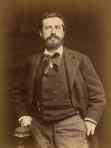 As August draws to a close, I have been thinking of another summer, that of 1871, and Frédéric Auguste Bartholdi’s first visit to America. Bartholdi, the French sculptor who would design the Statue of Liberty, spent four months in the United States that year, meeting with people in cities along the East Coast to discuss the idea of a liberty statue and then traveling west across the country, to California. From the window of his train he looked out on the plains of the Midwest, on high plateaus, mountains and valleys, and an abundance of wildlife that is difficult to imagine today—one herd of buffalo, he estimated, numbered around one thousand.
 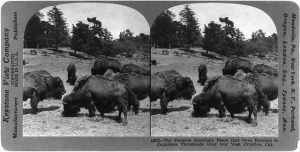 He spotted an Indian woman with a child on her back, he recorded in his journal shortly after leaving Omaha, and marveled at scenes that were like “something out of a fairy tale.” Bartholdi was mesmerized by the scale and beauty of the land he traveled through; it lifted his soul and colored his imagination. By the time he was heading back east his journal entries, previously brief, had become poetic. “For some time we passed through superb forests, to which the autumn has begun to give the most lovely tints. The bindweed and Virginia creeper, in autumnal colors, stretch from one tree to another as if to enclose the forest recesses, which are already being invaded by the woodman’s axe. These plants, like a band of voluptuaries, with their feet in the rich, swampy earth and their heads bathed in sunlight seem to indulge in gestures of the wildest extravagance.”
Bartholdi’s experience of America that summer convinced him to pursue the idea for a liberty statue, and established an enduring personal commitment to the project.
July 4 reopening of the Statue of Liberty
July 4, 2013
The Statue of Liberty reopened today after being closed to the public for nearly two years. Following the 125th anniversary celebration of the statue’s unveiling, on October 28, 2011, the statue was closed for a planned interior renovation project. The greatly anticipated reopening a year later included new public access to her crown—but lasted only one day! On October 29, 2012 Superstorm Sandy closed the island and left behind considerable damage. But today the island and the statue celebrate the Fourth of July by welcoming visitors once again.
CBS This Morning, “Statue of Liberty reopens eight months after Sandy”
FRK Collection
May 10, 2013
The Ryerson & Burnham Libraries at the Art Institute of Chicago started a Fazlur R. Khan Collection in 1992 when my mother donated some of my father’s papers and slides. There were still other files of his at home, and I looked through these as carefully as I could when I was working on Engineering Architecture. Now that the book is completed, I have decided to donate the rest of his papers so they can all be in one place. I will eventually also donate most of his slides (I want to sort through them and keep personal photos). The Collection does include some personal items, such as my father’s passport from the 1970s, to which a remarkable number of extension pages were added because of his extensive travel, a matted photo of a project given to him by Bruce Graham and signed “Another fine collaboration,” and the transcript of an oral history recording made by him in 1978.
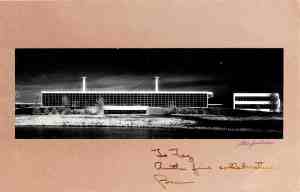
“To Faz, Another fine collaboration,” Bruce” (this image is included in Engineering Architecture on page 255)
Construction’s Man of the Year
January 21, 2013
I have added the full text from Engineering News-Record‘s 1972 article about my father “Construction’s Man of the Year: Fazlur R. Khan” to my website dedicated to him (here is a link).
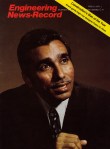
Cover of Engineering News-Record, February 10. 1972, Construction’s Man of the Year issue
It was during an interview for this article that he discussed his perspective on the role of engineering, saying “The technical man must not be lost in his own technology. He must be able to appreciate life, and life is art, drama, music and, most importantly, people.”

This memorial plaque for the lobby of Onterie Center in Chicago features my father’s statement from the ENR interview
Liberty Island
December 24, 2012

Brick pavers dislodged from Sandy’s storm surge.
From http://www.nps.gov/stli/after-hurricane-sandy.htm
The day after the crown’s reopening on October 28, 2012, Liberty Island was closed to visitors because of Hurricane Sandy. Considerable damage occurred at the island and a date for reopening has not been set. Yet, based on an initial assessment, the National Park Service reported that the statue appears to have withstood the storm without damage. This is especially remarkable considering that the engineers in 1880 had relatively little information about the wind forces in New York Harbor.
Statue of Liberty Reopens
October 27, 2012
This Sunday, October 28, visitors will once again be able to climb the steps inside the Statue of Liberty (now 393 steps) to reach her crown. The statue has been closed for interior renovation since the 125th anniversary ceremonies last October. Scheduled for this Sunday, the statue’s reopening will commemorate her unveiling in New York Harbor 126 years ago.
On the morning of October 28, 1886, people filled New York City sidewalks, crowded around windows and onto balconies, gathered on rooftops, and even perched themselves on lampposts and telegraph poles. A spectacular event was planned for the day to celebrate the unveiling of the Statue of Liberty in New York Harbor, beginning with a parade down Fifth Avenue, leading to lower Manhattan and Battery Park. The several-mile-long procession moved past Madison Square and the reviewing stand erected for U.S. President Stephen Grover Cleveland, who presided over the day’s ceremonies, then past Wall Street, where young men at the Stock Exchange leaned out the windows and inaugurated what has since become a tradition of the “ticker tape parade.”
Following the parade in Manhattan, attention shifted to the grand statue in the harbor as spectators prepared for speeches at Bedloe’s Island and the unveiling of the statue’s face. As the light raised by this magnificent statue shines on these shores, President Cleveland proclaimed, it will reflect on the shores of our sister Republic across the Atlantic and “pierce the darkness of ignorance and man’s oppression until Liberty Enlightens the World.”
This Sunday the 126th anniversary of the statue’s unveiling will be marked by the reopening of her crown to visitors. Unfortunately I cannot make the climb myself, due to my health. But I encourage anyone who is able to do so. The exhilarating view is unmatched. And, as you look out over the water, you may even sense the expansive vision of enlightenment that shaped this unique national monument, the Statue of Liberty Enlightening the World.
American Friends of Lafayette
June 19, 2012
I just returned from the annual meeting of the American Friends of Lafayette, which took me to Washington, D.C. This year’s program was especially exciting for me because we visited a couple of places that I mention in Enlightening the World: The Creation of the Statue of Liberty. We started our tour with a visit to Mount Vernon, where Washington displayed the key to the Bastille that Lafayette sent him after the fall of the Bastille on July 14, 1789. 
 Washington’s home was already open to the public in 1871 and Auguste Bartholdi (the statue’s sculptor) came here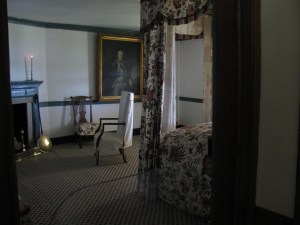
during his exploratory visit to the U.S. and saw both the key and “Lafayette’s Room.”
In the afternoon we were treated to a special visit to the chamber of the U.S. House of Representatives to see the portrait of Lafayette by Ary Scheffer. Scheffer gave the portrait to Congress in 1824-25 during Lafayette’s spectacular 13-month-long “guest of the nation” tour of the United States. The House of Representatives commissioned a portrait of George Washington for the other side of the speaker’s rostrum—and the portraits of these two Revolutionary War heroes have hung together in the House Chamber since the 1830s (they were moved into the new Chamber when the House moved in 1858). 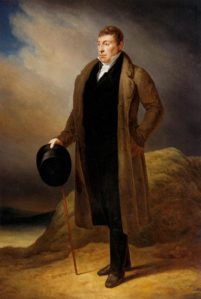
 Yasmin Sabina Khan